CARP - MdM 20/2 2007 - 2027 EN
CARP 1
With this document, we are effectively entering the documented history of CARP.
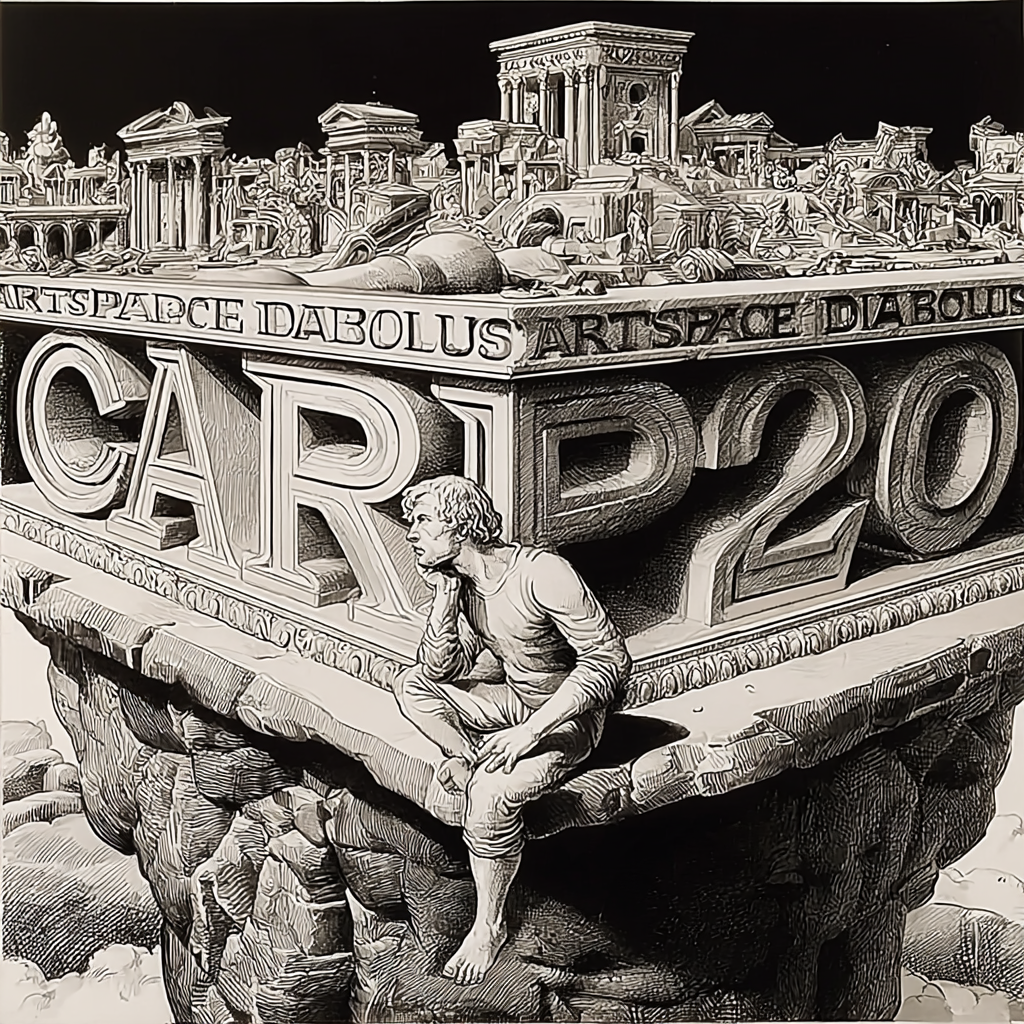
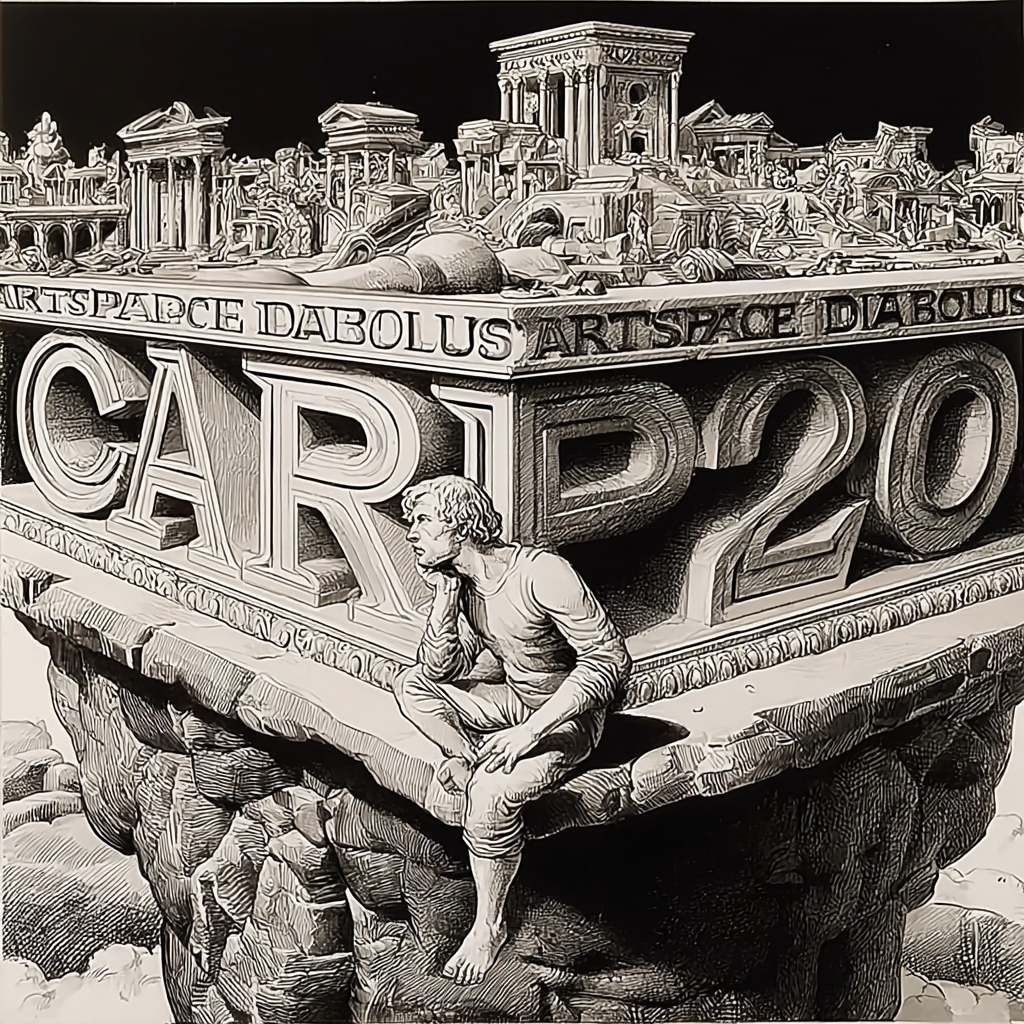
The carp-01.pdf is not merely an exhibition catalogue: it is, in fact, a founding document, a research programme, a catalogue of works and a methodological manifesto all in one. The most important realisation is that we no longer need to reconstruct the formation of CARP retrospectively, relying solely on memory. The document records, from within the group itself, how it came into being in 2007. According to Josina Burgess’s account, the story begins in the Cetus District: it was there that she encountered the works of Caravaggio Bonetto and Velazquez Bonetto; she later modelled for Velazquez’s series of avatar photographs; and a conversation about MANAX gave rise to their first joint MANAX project. They then collaborated on moving and sound-producing sculptures, ‘dancing scarecrows’, flying images and other experiments. The decisive sentence literally states that Velazquez came up with the idea of involving further SL artists; Yoshikawa Juria, nnoiz Papp, Caravaggio Bonetto and MANAX were invited, “and so CARP was born”. This is extremely valuable from a historical perspective, as it links the three previously identified phases: CETUS → MANAX and early joint experiments → CARP. In other words, CARP did not begin with an administrative decision, but with the institutionalisation of a collaborative practice. The document’s title page already clearly uses the term ‘cybernetic art research project’, within the framework of the Diabolus Second Life Virtual Art Space. The cover page specifies the period from 1 November to 31 December 2007. The internal project description, however, states a programme running from 1 November to ‘31 November’ — the latter being an obvious error, as November does not have a 31st day. We will mark this in the historical apparatus as a discrepancy in the source dates; we will not correct it without comment. The documented core group of CARP 1 consisted of six people:
- Caravaggio Bonetto — Naomi Devil
- Velazquez Bonetto — László Ördögh Diabolus
- Josina Burgess — Jose den Burger
- nnoiz Papp — Tobias Becker
- Juria Yoshikawa — Lance Shields
- TheEvil Chemistry / MANAX
The project’s venue is the Virtual Art Space Diabolus, Benvolio, owned by Josina Burgess, Velazquez Bonetto and Caravaggio Bonetto. The document even records the area’s details: 11,608 square metres, 2,808 prims. The CARP 1 opening is scheduled for 24 November 2007, at 2 pm SLT. However, the real historical significance begins on pages 6–7. Here we find the ‘CARP idea tree’, that is, the first explicit CARP research model. The aim of the project is to explore the audiovisual possibilities of Second Life. The programme is divided into two main phases: Creation and Publication of the Outcome. In the first phase, each participant selects certain SL audiovisual components, identifies research objectives, experiments, creates new effects and scripts, and then develops these into works within the ‘Idea Tree’. The outcome of the second phase is an exhibition, a PDF e-book, and the sharing of the created audiovisual components and scripts amongst the participants. The latter is particularly important. CARP therefore does not operate as an object-centred artistic model even in its first project. The aim is not for every artist to ‘create their own work’, but for participants to create components, algorithms, scripts and operating principles, and then share and recombine these with one another. Page 7 also sets out the ethical and organisational principles underpinning this:
“Open communication, co-laboration and co-operation”
“Open exchange of ideas and know-how”
“Open exchange of audiovisual components and scripts”
This is followed by one of CARP’s most characteristic statements:
“There are no rules. Innovation is not bound by any rules.”
And the second rule is, in essence, that, following on from the first, there are no further rules.
This is more than just a playful turn of phrase. It describes the open research protocol governing CARP’s operation: communication, cooperation, knowledge sharing, component sharing and experimentation. Another key concept in the document is ‘Art Scripting’. In its analysis of Black & White Synesthesia, the text states that audiovisual events must be organised into a structured, dramatised form. To achieve this, the separate prims must communicate with one another so that the effects can be synchronised in space and time. The document distinguishes between two LSL communication models: prim-channel communication and linked-prim-set communication, and applies both in various CARP works. At this point, I believe what we will later term Hyperfunctionalism is already clearly evident. Form does not exist in isolation, but is the visual manifestation of a functional system. The prim is not a simple geometric element: it is a communicating, sensing, reacting, time-varying component. Even more important is the CARP Matrix featured on the following page. The document describes this as a collection of script modules that can be combined; their combined operation often produces results that are unpredictable but visually interesting. In my view, this is one of the most important early concepts in the history of CARP. The CARP Matrix is, in fact, a primitive generative/procedural media system: it does not define a single work, but rather a modular set of rules and behaviours from which various works can emerge. This also establishes a direct link to the later idea of ‘création de la création’: it is not necessarily the creation of the object that is the most important creative act, but the creation of the system capable of generating objects, events and behaviours. The works in CARP 1 demonstrate this in practice. In Caravaggio Bonetto’s Muybridge Voxel Kino installation, the concept and realisation are by Caravaggio, the sound by nnoiz Pappé, and the scripting by Velazquez Bonetto. In the case of Caterpillar Loves You, Caravaggio’s concept, nnoiz’s sound, Velazquez’s scripting and Josina’s scripting idea are brought together. Black & White Synesthesia is based on Velazquez’s concept and scripting, nnoiz’s sound design and Juria’s ‘solid/flexi’ idea. The same division of labour is repeated in Josina’s works Cable Biothops, Dino, Breathing Blocks, And Then There Was Light and Aurora Sphere, as well as in Juria Yoshikawa’s installations Time-Space Drawing, Flex Metal, Two Prim Behaviors, Mother of the CARP Matrix, Living Spaghetti Monster, Space Dahlia, Jura Age and Spaghetti Storm. In a significant number of the works, the concept and visual idea come from one artist, the scripting from another, and the sound from a third. Therefore, we should not describe CARP 1 simply as a group exhibition. A more accurate description is: CARP 1 was a collaborative, modular cybernetic art research laboratory. Moreover, Josina’s recollection also describes the psychology of the division of labour very precisely: she characterises herself as ‘Alpha’, who starts from feelings and expression, and Velazquez as ‘Beta’, who translates these ideas into functioning scripts and structures. This is, of course, her personal description from that time, not a general psychological category, but as a historical source it illustrates extremely well how the two parties interpreted their collaboration. And there is another particularly valuable document in the book: on page 25, Velazquez Bonetto himself explains why he came to Second Life. He describes SL as a dematerialised world, an experimental space characterised by a high degree of abstraction, where ideas can be tested free from the financial, organisational and material constraints of the real world. He particularly highlights the plan for an avatar museum, the avatar as a tool for metacommunication, and the fact that Second Life is an “ideal platform to research and experiment with the art of the future”. This is, in effect, Velazquez Bonetto’s first documented artistic manifesto. We can therefore now refine our previous historical model: November–December 2006: CETUS, incubation, learning, exhibitions, networking.
First half of 2007: Josina–Velazquez collaboration, MANAX, experiments with scripting, particles, light, sound and movement.
Autumn 2007: the collaborative circle expands to include Juria Yoshikawa, nnoiz Papp, Caravaggio Bonetto and MANAX.
1 November 2007: CARP 1 – the start of the Cybernetic Art Research Project’s formalised research programme.
24 November 2007: documented CARP 1 opening. With this, I believe we have reached the first point that we can already call a firm historical juncture: 2007 – the birth of CARP: the virtual gallery becomes a research laboratory. And it is already clear that we must trace three parallel axes for the subsequent history: people, projects, and technical/artistic concepts. For CARP 1 already contains almost every fundamental motif that would later emerge: cybernetic installation, art scripting, effect networking, synesthesia, communicating objects, sensors, collaboration, open script exchange, generative combination and the involvement of the viewer’s avatar in the functioning of the artwork.