CARP - MdM 20/1 2007-2027 EN
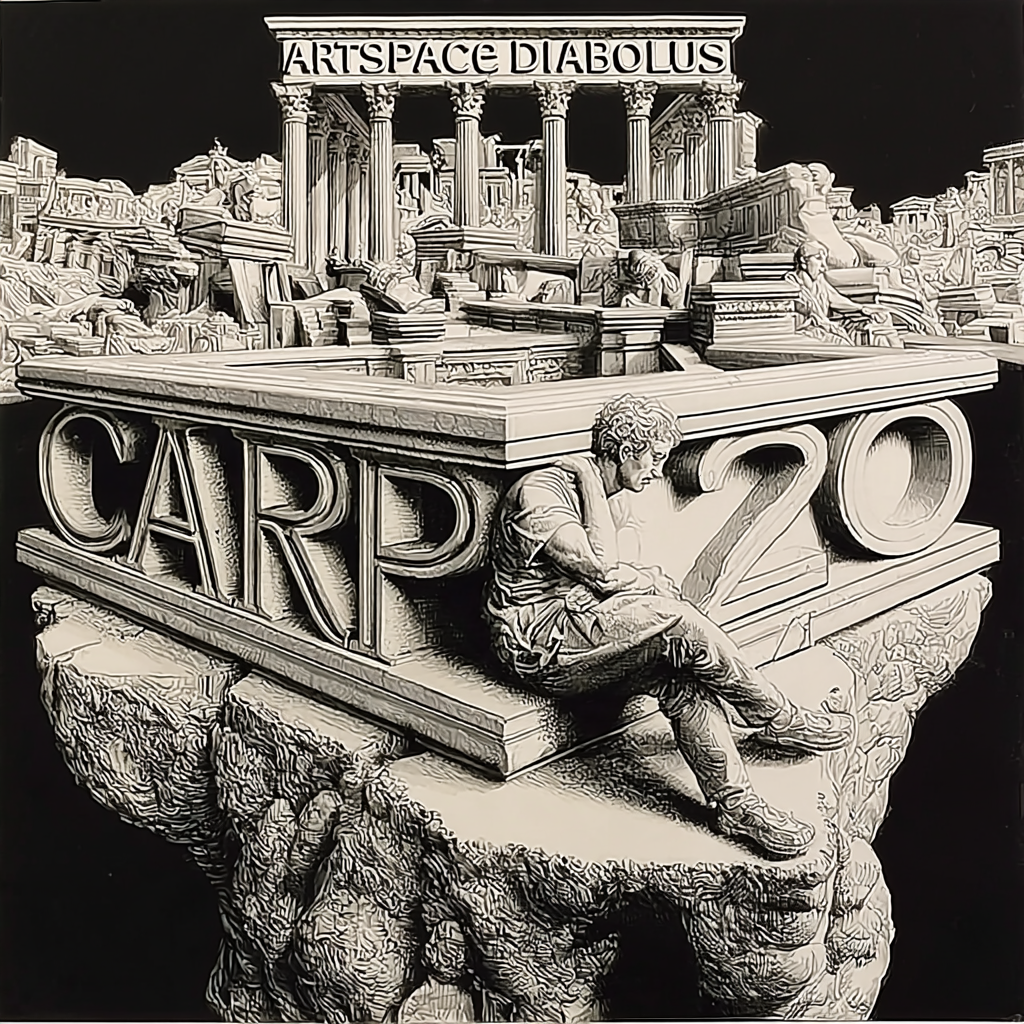
CARP-0
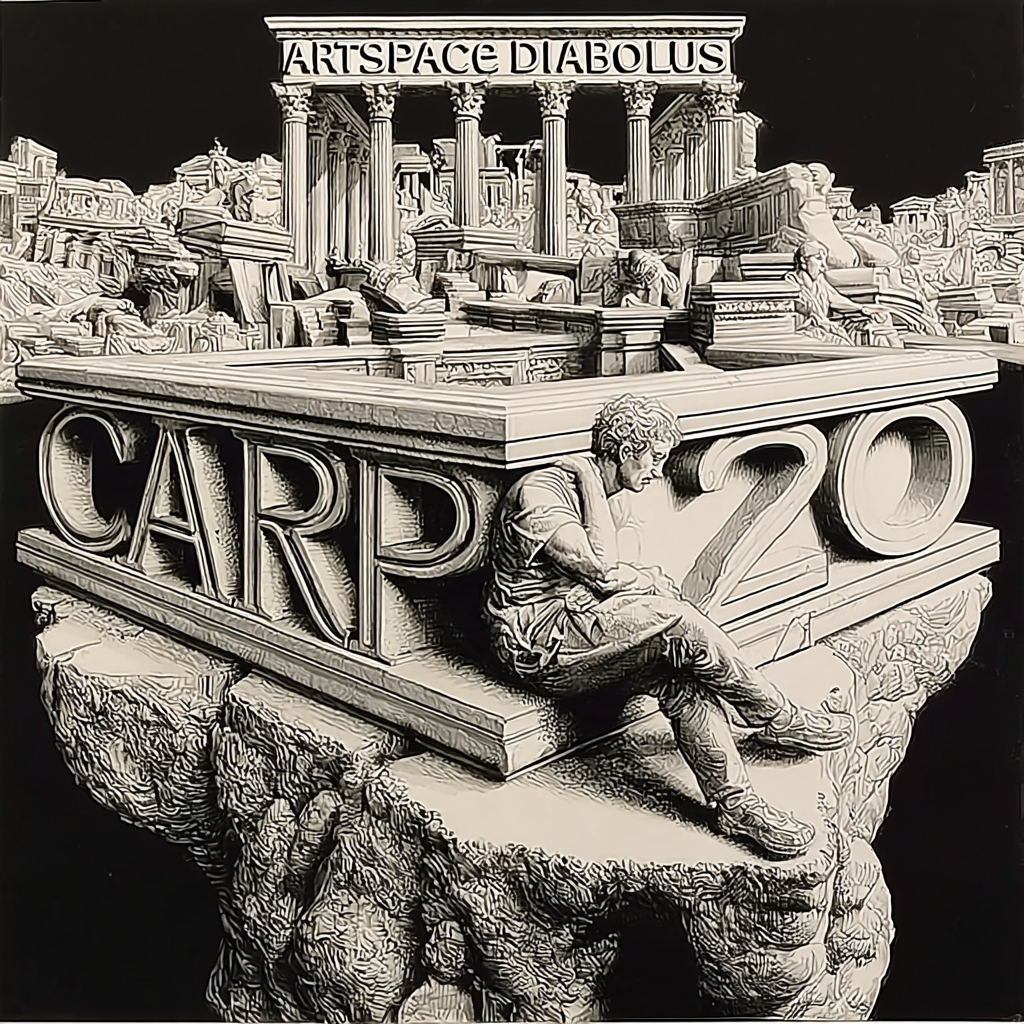
The CARP Story (EN) Part 1
(Conversations with Myself)
The goal would be to create a historical summary of CARP. This is no small task, as it involves an artistic era with hundreds of figures, hundreds of documents, and many locations. Even from the initial preliminary search, it’s clear that a surprisingly rich body of source material can be compiled for this. My PDF library contains approximately 150 CARP project documents. The Velazquez Bonetto Archive, for example, features a separate “CARP storyline” covering the history of its founding, the CARP 1–7 programs, VJAZZ, the Wall, Rings, and Metropolis projects, as well as detailed creative credits. The documentation for SL TLC can also be found there, which documents the 2010 Second Life reinterpretation of Nicolas Schöffer’s Tour Lumière Cybernétique. (Velazquez Bonetto’s Metaverse Art) The 2010 Metaverse Art publication will be particularly valuable because it is not simply a retrospective account: it is a contemporary CARP document featuring artist testimonials, project descriptions, names of individuals, technical procedures, and photographic documentation. For example, it details the formation of VJAZZ and the division of labor in the Metropolis production. (doczz.net) The description of the contemporary Art Space Diabolus Flickr group, meanwhile, dates the founding of Art Space Diabolus in Second Life to June 24, 2007, and names Velazquez Bonetto, Caravaggio Bonetto, and Josina Burgess as its founders. (flickr.com) A retrospective source from 2022 discusses CARP from a historical perspective and identifies 2007 as the year of its founding in Second Life. (hgsafari.blogspot.com) I therefore propose the following research structure:
- Source corpus. We will collect websites, blogs, books, PDFs, Flickr materials, videos, interviews, invitations, festival documentation, and Second Life and OpenSim sources. For each item, we will record the date, author, source type, and whether it is a primary or secondary source.
- CARP Master Timeline. We reconstruct the history by year, then—as needed—by month and day: background → 2007 launch → CARP 1, 2, 3… → major productions → institutional partnerships → the post-Second Life era → OpenSim/Craft and subsequent developments.
- Participant Database. A separate record for each person: real-life name, avatar name, any additional aliases, country, artistic/technical field, role in CARP, projects, and sources. This will be indispensable if we are indeed talking about several hundred participants.
- Project database. For each production: title, date, location/simulator, concept, participants, technology, music, scripting, performance, documentation, and historical significance. Projects such as The Wall, Rings, VJAZZ, Metropolis, EMOTICON, SL TLC, etc., will thus receive their own “dossier.”
- Venue history. Art Space Diabolus, Benvolio, Jourdain, and the various Second Life/OpenSim venues were not merely coordinates, but studios, laboratories, stages, and meeting places. It is worthwhile to reconstruct these as a separate network.
- History of technology and media. LSL scripting, sculpties, particles, avatar animation, camera systems, automated timelines, interactive environments, collaborative improvisation, 4D cinema, etc. This demonstrates that CARP did not simply organize virtual exhibitions but explored the functioning of the medium itself.
- Context in the history of ideas and art. Cybernetics → Schöffer → procedural and kinetic art → network art → virtual worlds → Hyperformalism → CARP-style hyperfunctionalism, collaborative and performative practice. This will ensure that CARP is not presented as an isolated Second Life phenomenon.
Therefore, in my opinion, the final product should not simply be a “CARP summary,” but rather something like “CARP—The History of the Cybernetic Art Research Project, 2007–…”. This would consist of a short, readable narrative, followed by a much more detailed chronology, list of participants, project catalog, and bibliography. In this way, the hundreds of names would not overwhelm the main text, yet the material would remain accessible for research. I would like to establish the most important methodological rule right at the outset: one must not automatically treat everything a CARP member writes on their own page as fact. Such material is extremely valuable as a primary source, but wherever possible, we cross-reference it with contemporary invitations, accounts by other participants, books, videos, festival websites, and independent publications. We do not gloss over contradictions; instead, we highlight them. This is particularly important when documenting the history of a decentralized art network like CARP, which operates using avatar names. The sheer volume of material is not an obstacle here: we can process it in batches while continuously building the same chronology and participant database. As the next concrete step, I would begin researching sources from CARP’s “founding period” between 2007 and 2010. Based on this, we can create the first verified timeline, and from there it will very quickly become clear into which chapters we need to divide the entire history of CARP. OK, the plan looks good, and I’ll also provide all the contemporary PDF documents I have available. Let’s start with the period before CARP. The first important realization is that this era should perhaps be called not simply the “pre-CARP period,” but the “CARP 0 / proto-CARP era”. This is because all three 2007 publications explicitly state on the title page that they were created by the “CARP 0 team”, even though the organizational context is still listed as “Diabolus – Second Life Virtual Art Space (Benvolio)”. The three names listed on the title page in all three cases are: Josina Burgess (Jose den Burger), Caravaggio Bonetto (Naomi Devil), and Velazquez Bonetto (László Ördögh Diabolus). This is historically very significant. It appears that the concept and name “CARP” already existed in 2007, but not yet the extensive international network that we later came to know as CARP. CARP 0 was likely more of a laboratory-like, experimental nucleus: three people, a virtual art space, a new medium, and experiments emerging in rapid succession. The copyright pages of all three books list 2007, so we can already establish this as a primary source. Moreover, taken together, the three documents are not merely a catalog. Their very structure reveals a research program. The yes entry begins with the problem of entry: avatar history, Cetus, “SL slum,” and then “escape from the slum.” The first major theoretical section begins with William Fetter and traces the history of computer-based human modeling. It is particularly interesting to us that the OSCAR system is also included: according to the text, it evolved from a program launched by the Hungarian Design Council in 1981 and became market-ready by 1986 as a PC-based human model. This will prove extremely important later on, because it means we won’t necessarily have to interpret the history of CARP starting in 2007. The document itself constructs a technological genealogy: computer-based human model → virtual human → avatar → metaverse. #dance documents a second step. Even the terms in the table of contents are telling: RLinSL, RL2SL, SLinSL. I believe these should not be read simply as chapter titles, but rather as three distinct media operations. The first transposes a representation of the real world into Second Life; the second transforms a real-world artwork within the virtual environment; and the third refers to a work whose original medium is Second Life itself. One of Josina Burgess’s texts describes this in an almost programmatic way. She explains that in an early virtual sculpture, she moved transparent spheres and ovals using a script, and then realized that the viewer is no longer standing in front of an object but is entering the artwork, continuously encountering new perspectives as they move. Elsewhere, she writes that images of her actual paintings were broken down into pieces, placed on flexi-prims, and these image elements then floated, rotated, and “danced” in space. This is a very important shift: the reproduced image becomes a virtual event. #automat takes this even further. Here, the MANAX project emerges, in which visual installation, avatar, narrative, poetry, sound, music, scripting, and particle systems merge into a single complex work. According to the documentation, Josina Burgess wrote the MANAX story, 5imon Baker narrated it, Cypress Rosewood composed the music, and Velazquez Bonetto created a new “Light Organ” that generated MANAX images and light particles. The system could be operated manually or in automatic mode, and the particles appeared both around and beneath the viewer. The text itself describes the entire project as a synesthesia-based project. And here something happens that I believe will be one of the keys to understanding the entire CARP story. The #automat no longer simply documents a “virtual exhibition.” The work behaves. It changes over time. It is controlled by a program. It responds to sound, commands, and automation. And the visitor is not an external observer but is situated within the generated event space. This is already very close to what we will later see as CARP’s practice of procedural, performative, and cybernetic art. Moreover, the same brief theoretical statement appears at the beginning of all three books: cybernetics → cyberspace → metaverse. The publications are dedicated to William Fetter, and the artistic use of the virtual universe is declared an avant-garde task. This shows that CARP 0 no longer defined itself as a casual Second Life artist group, but rather sought to situate its own activities within the history of cybernetics, computer graphics, and virtual space. The cover does not simply read “Velazquez Bonetto,” but “Velazquez Bonetto (László Ördögh Diabolus)” . At the same time, the word “Diabolus” also becomes an institutional name: Diabolus Second Life Virtual Art Space. In other words, Diabolus here is both a personal artist name and the name of an artistic system, while Velazquez Bonetto is the avatar identity operating within this virtual system. Therefore, I would structure our first provisional chronology as follows:
- Technological and Artistic Precedents—computer graphics, human models, cybernetics, avatars; specifically, William Fetter and, later, the OSCAR line.
- Entry into Second Life—the discovery of the virtual environment as a new artistic medium.
- Diabolus Virtual Art Space, Benvolio—the creation of the virtual studio/gallery/laboratory.
- CARP 0 – 2007 – A documented core group consisting of Josina Burgess, Caravaggio Bonetto, and Velazquez Bonetto.
- yes entry – avatar, virtual space, and virtual architecture.
- #dance – RL → SL transformation; a moving, navigable, and medially autonomous virtual artwork.
- #automat – scripting, automatism, particle system, music, narration, synesthesia; the work as a functioning system.
- Transition from CARP 0 to CARP – the point at which a larger international collaborative network forms around the three-person experimental core.
And here I would like to introduce an important methodological rule for our future work: we will not yet write these eight points as a final narrative. We now consider this to be a version 0.1 narrative model. With each new document, we will confirm, modify, or reject certain parts of it. This way, we can avoid the problem of projecting our later recollections back onto 2007. From this point on, I would therefore treat the three books just uploaded as the CARP ARCHIVE / A01–A03 core corpus: Simply upload the following documents one after another. In the meantime, I’ll integrate them into the same system, and we’ll gradually build up the CARP 0 chronology, network of participants, project list, and history of concepts. With this, we’ve effectively begun the historical reconstruction of CARP. As you quite correctly noted, the period from November to December 2026 was more of an incubation period—a time for learning and getting acquainted. Essentially, the CETUS Gallery sim served as our temporary home, where we organized exhibitions and events. In this phase, the CETUS Gallery sim can be considered our first temporary base. It wasn’t yet our own, permanently established institutional space, but rather an environment where we could experience the workings, social customs, and technical possibilities of Second Life, while actual artistic activity was already taking place: exhibitions, events, gatherings, and our first spatial experiments. This aligns nicely with the yes entry document as well: it includes a separate “cetus” chapter, subtitled “The 4th generation avatars in action,” and the pages that follow document gallery scenes, exhibitions, avatars, and virtual art environments. I would therefore clarify the historical structure as follows: November–December 2006 — incubation phase / CETUS period.
Entry into the world of Second Life; learning the system; using avatars; mastering building, object management, communication, and event organization. The CETUS Gallery serves as a temporary home for a while. Artistic activity—exhibitions and events—is already taking place, but the CARP structure has not yet been established. Early 2007 — creation of a dedicated art space.
After gaining experience, the Diabolus Virtual Art Space / Art Space Diabolus environment is established. With this, operations transition from the gallery space used as a guest venue to a dedicated, experimental art infrastructure. 2007 — CARP 0.
The earlier learning and exhibition practices began to evolve into a regular experimental program: avatars, virtual architecture, RL–SL transformation, scripting, automatism, particle systems, sound, performance, and collaboration. This periodization is also useful because it avoids the mistake of projecting CARP back onto 2006 in its finished form. At the end of 2006, learning and exploring the environment were still underway; in 2007, this began to evolve into a distinct artistic system. For this reason, I would not treat CETUS merely as a venue in the subsequent narrative, but rather as the first space for artistic socialization. It was there that existing artistic and technical experience encountered the unique logic of Second Life. We can now record this in the chronology as follows: November–December 2006: CETUS / incubation
→ Early 2007: Diabolus’s own space
→ 2007: CARP 0
→ Later: CARP era This is already beginning to outline a genuine historical arc very clearly.